Structural geology field note
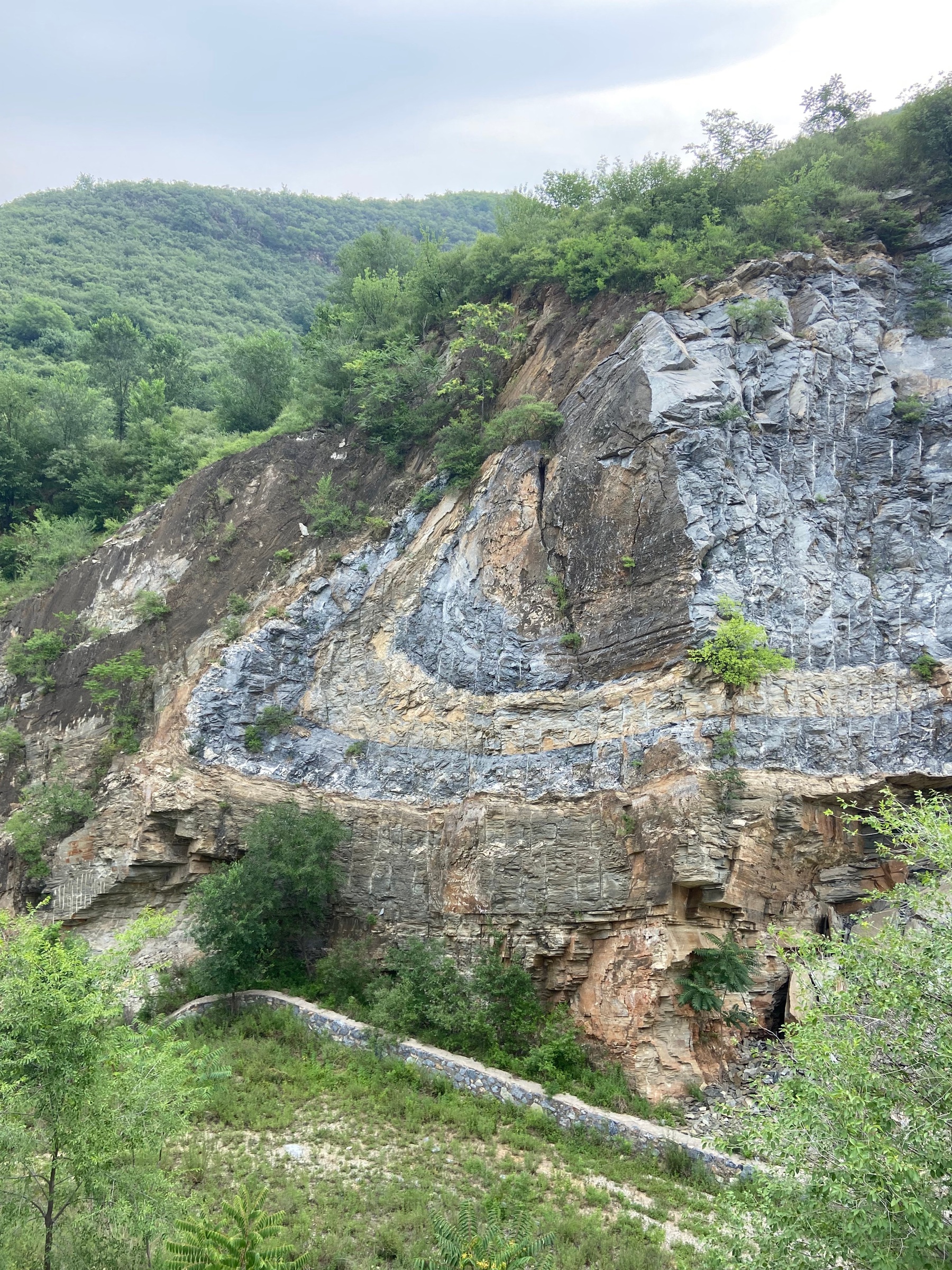
An inverted fold with a thickened hinge
This outcrop records ductile material flow during folding, together with a much older gap in the preserved rock record.
- Hinge trend
- 095°
- Dip
- 5–10° east
- Locality
- Geological field observation
Why the hinge is thicker
The thickened hinge is interpreted as the result of material flow during deformation. The outer limestone layer is mechanically softer, whereas the inner layer is more competent. Compression along the fold limbs drove the more ductile outer material toward the hinge, where it accumulated and cooled into the thickened geometry visible in the photograph.
The distance between two adjacent fold crests is the wavelength, conventionally written as λ. Layer thickness, material viscosity and mechanical contrast all influence the final fold geometry.
A missing interval in the rock record
The arrowed contact shows clear stratification. Isotopic dating indicates that the upper limestone formed approximately 0.5–0.8 billion years ago, whereas the lower phyllite formed approximately 1.0–1.2 billion years ago. This leaves roughly 200 million years of rock history unrepresented at the contact.
No obvious weathering crust is preserved along the boundary. One interpretation discussed in the literature is that the older surface was covered during a glacial interval; after the ice retreated, the rock was exposed again and younger sedimentation resumed. The contact therefore records both deformation and a substantial hiatus in deposition or preservation.