DAS and machine learning
Vehicle Weight and Speed Recognition with DAS
Connecting roadside observations with fibre-optic waveforms
Distributed acoustic sensing turns an optical fibre into a dense array of vibration measurements. Vehicle passages produce coherent trajectories in time–distance records, but using those signals for vehicle characterization requires reliable alignment between the DAS wavefield and independently observed vehicles.
- Data
- DAS traces and roadside imagery
- Targets
- Vehicle speed and weight
- Contribution
- Matching, labelling, and waveform analysis
01
Building labelled observations
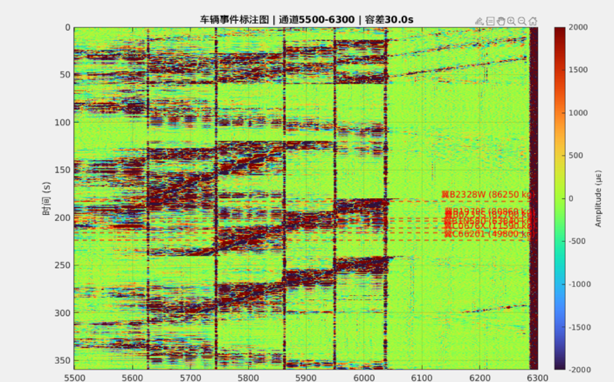
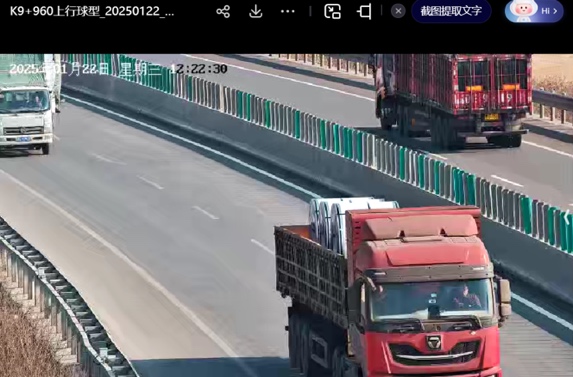
I developed a workflow to match manually captured vehicle images with the corresponding DAS traces. The association links a visible vehicle passage to its trajectory across sensing channels, providing labels that are otherwise absent from the fibre-optic data.
Accurate matching is essential because traffic can be dense and several trajectories may overlap. Timing, travel direction, lane position, and the slope of the DAS trajectory together constrain which waveform belongs to each observed vehicle.
02
Reading motion from the DAS wavefield
In a time–distance representation, a moving vehicle generates an inclined coherent arrival. Its slope provides a direct constraint on speed, while the spatial continuity of the trajectory helps separate a vehicle signal from stationary or incoherent noise.
The waveform amplitude and spectral content may also contain information related to axle load and total vehicle weight. Those observables are influenced by additional factors—including vehicle type, lane distance, pavement response, and fibre coupling—so weight estimation requires calibration and uncertainty analysis rather than a single amplitude threshold.
03
Current contribution and scope
My contribution focuses on the data pipeline needed before model training: synchronizing visual observations with DAS data(though limited data due to random time shift of camera), extracting trajectories, assigning labels, and examining waveform features that may carry weight information.
The present work supports the development of a more reliable estimation model, but the supplied material does not yet establish a final accuracy or a deployment-ready system. Robust evaluation will require held-out traffic observations and explicit tests across vehicle types, lanes, environmental conditions, and fibre-coupling states.