Fault-zone geometry
The Geometry of Scale Dependence
Reconciling earthquake fracture energy with fractal fault-zone structures
Earthquake fracture energy is commonly normalized by an idealized planar rupture area, yet natural ruptures occupy finite-width fault zones containing gouge, subsidiary fractures, and off-fault damage. This project isolates one geometric question: how much structural information is lost when a three-dimensional fault zone is observed and measured on a two-dimensional plane?
- Focus
- Fracture-energy scaling
- Method
- 3D Voronoi modelling and stereology
01
The scale-dependent observation
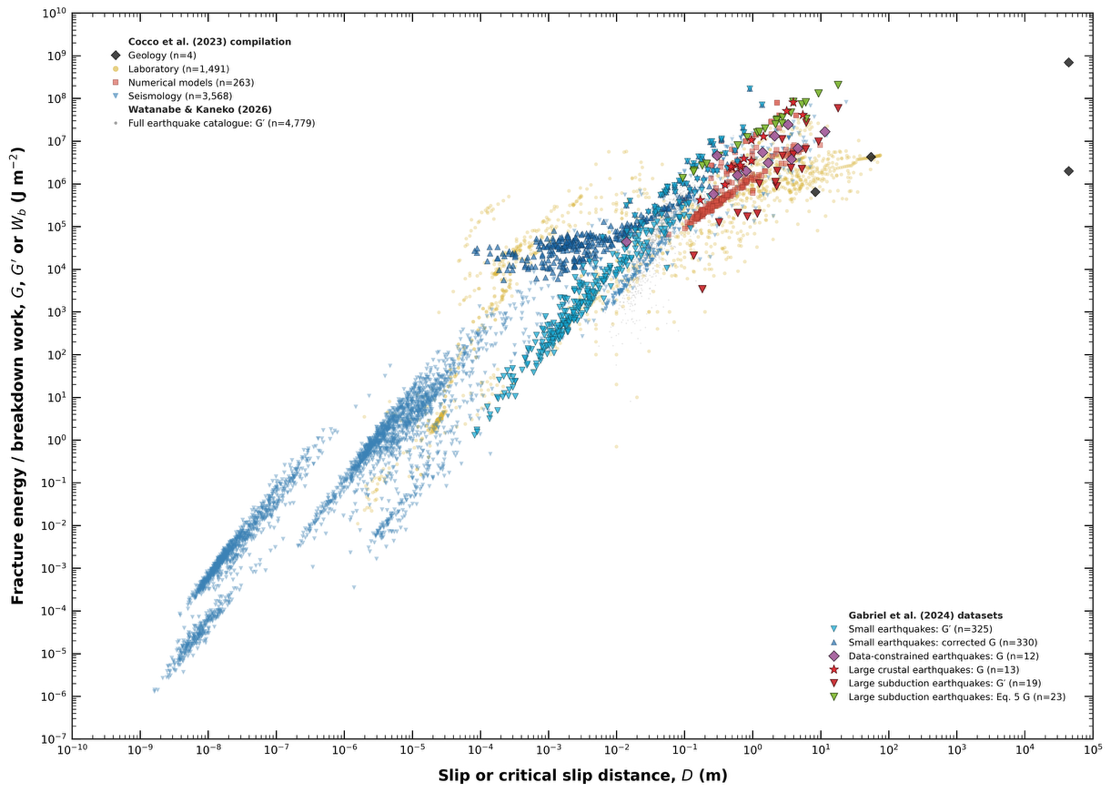
In Classic Linear Elastic Fracture Mechanics, fracture energy is defined as the energy needed to create per unit area of a new ideal plane in the material. It’s an intensive or intrinsic property of the material to quantify how hard it is to break down the atom bond to create a new surface, which means it would not change with system’s size. Earthquake-based estimates, however, span many orders of magnitude and tend to increase with slip.
Many explanations invoke scale-dependent weakening processes during rapid coseismic slip, including thermal and frictional mechanisms like flashheating. This study does not replace those mechanisms. Instead, it asks whether the geometry used to define rupture area introduces an additional, measurable bias.
02
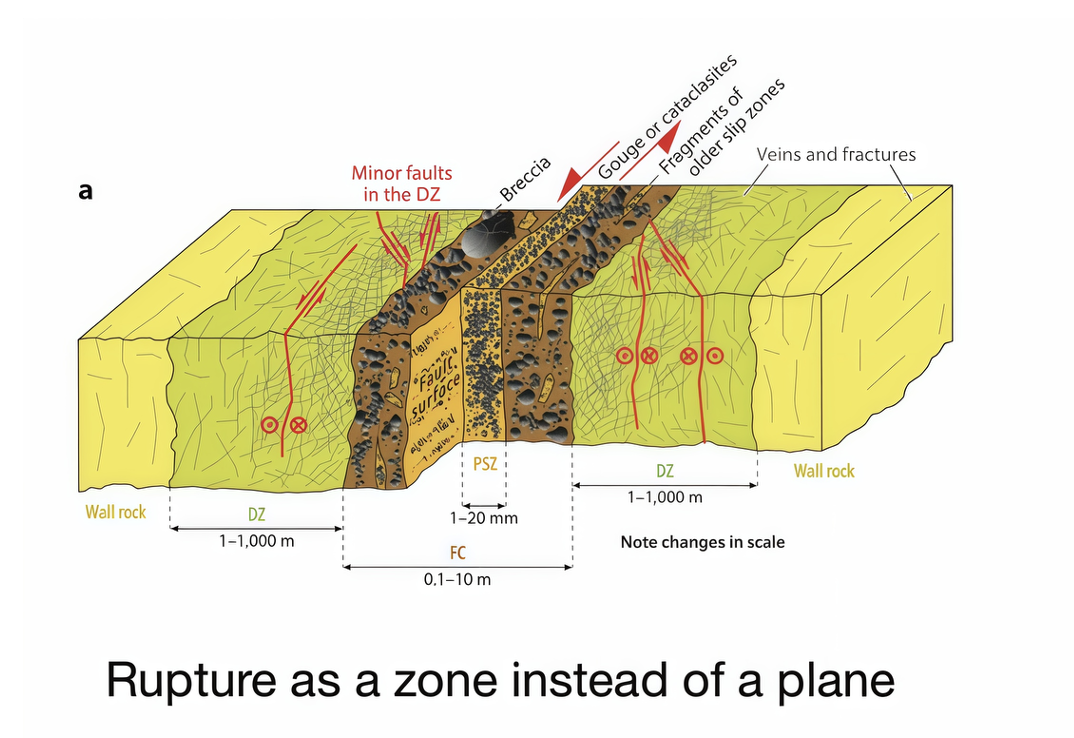
Rupture as a zone rather than an ideal plane
A mature fault contains a principal slip zone, a fault core, distributed gouge and cataclasite, subsidiary faults, and a damage zone extending into the wall rock. Energy can therefore be dissipated across a network of surfaces and deforming material rather than on a single mathematical plane.
If the true dissipative structure is volumetric but the inferred energy is divided by a planar rupture area, the effective area involved in failure may be underestimated which caused the scale dependence. The central objective is to quantify this dimensional-reduction effect before coupling it to more complete rupture physics.
03
A controlled stereological experiment
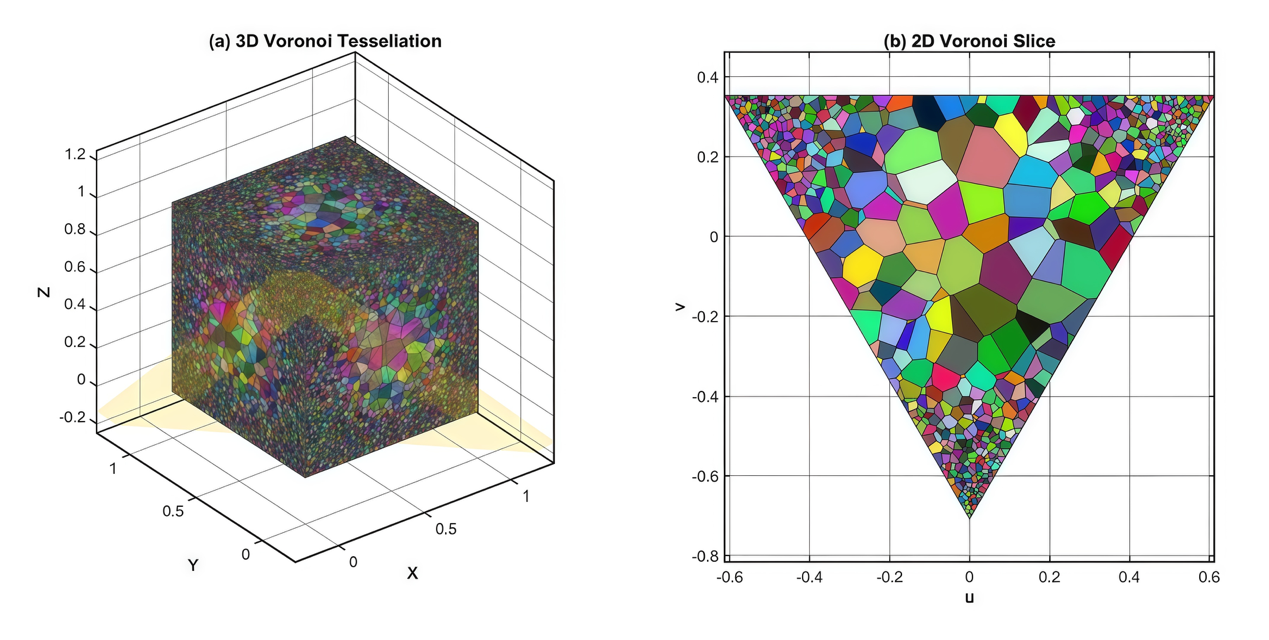
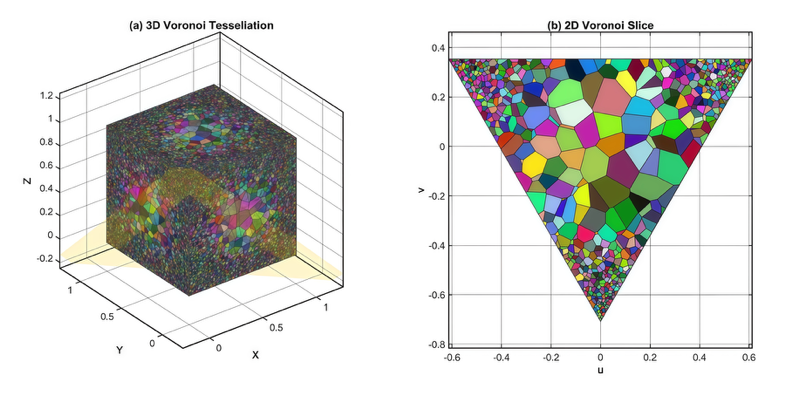
I construct a bounded, space-filling fault-gouge analogue using a three-dimensional Voronoi tessellation whose cell sizes follow a prescribed power-law distribution. The same realization is then intersected by planar sections, creating virtual outcrops that can be measured independently of the parent volume.
Because the three-dimensional body and its two-dimensional sections share the same underlying structure, differences between their recovered exponents can be attributed to dimensional sampling rather than to different geological histories or datasets.
04
From a 3D hierarchy to a 2D outcrop
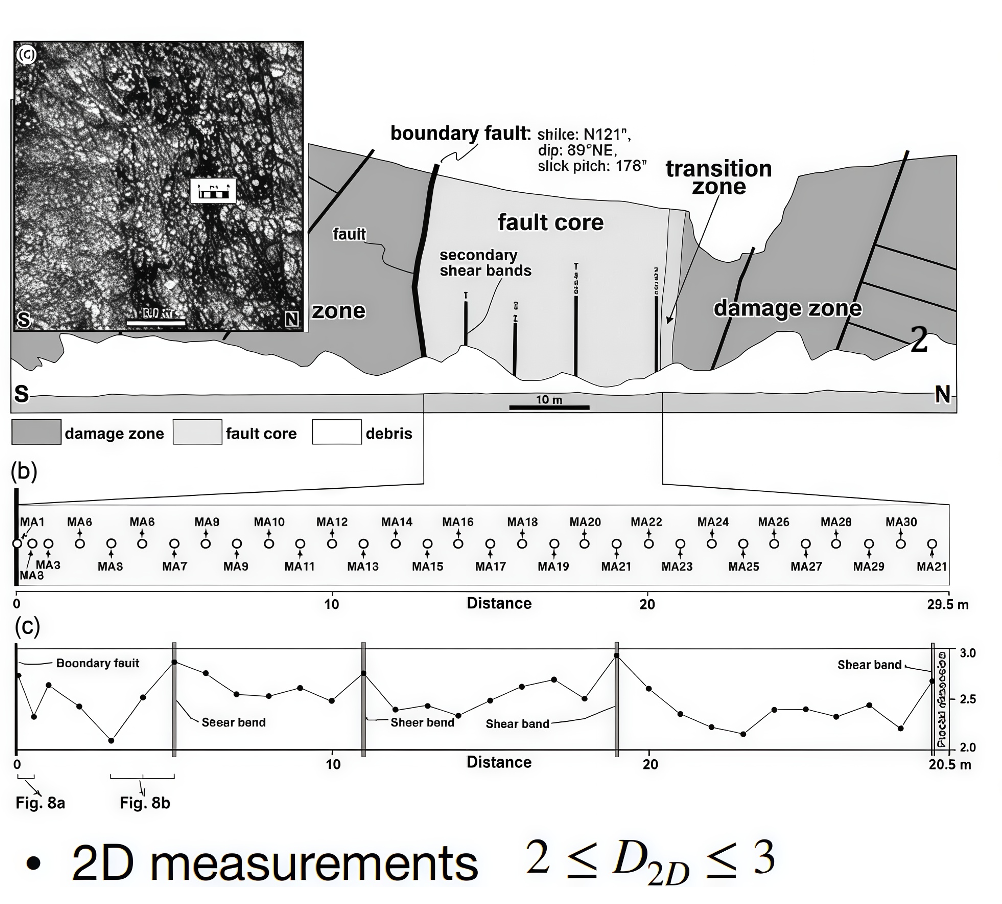
Outcrop studies of fault gouge commonly report two-dimensional particle-size exponents of approximately 2–3, whereas the modeled three-dimensional distribution used here can require an exponent greater than 4. This contrast motivates a direct test of whether planar sampling systematically reduces the apparent exponent.
The numerical sections retain a recognizable power law but recover a lower exponent than the parent volume. For a representative realization, the volumetric estimate is D₃ᴅ = 4.511 ± 0.022 and the planar estimate is D₂ᴅ = 2.913 ± 0.012. The result shows that a convincing 2D power law can coexist with substantial loss of information about the 3D hierarchy.
05
Interpretation and limits
The stereological bias provides a geometric contribution to apparent fracture-energy scaling: a planar description can undercount the distributed surface area and damage represented within a fault zone. It should be interpreted as a baseline correction, not as a complete mechanism for earthquake energetics.
The model is topological. It does not yet resolve dynamic rupture, thermal pressurization, frictional evolution, or the finite width imposed by the seismogenic zone. A next step is to couple the measured geometric bias to dynamic rupture calculations and test when the relation remains valid across scale.
Selected references
- Viesca, R. C., and Garagash, D. I. (2015). Ubiquitous weakening of faults due to thermal pressurization. Nature Geoscience, 8, 875–879. https://doi.org/10.1038/ngeo2554
- Cocco, M., Aretusini, S., Cornelio, C., et al. (2023). Fracture energy and breakdown work during earthquakes. Annual Review of Earth and Planetary Sciences, 51, 217–252. https://doi.org/10.1146/annurev-earth-071822-100304
- Gabriel, A. A., Garagash, D. I., Palgunadi, K. H., et al. (2024). Fault size-dependent fracture energy explains multiscale seismicity and cascading earthquakes. Science, 385, eadj9587. https://doi.org/10.1126/science.adj9587
- Billi, A., and Storti, F. (2004). Fractal distribution of particle size in carbonate cataclastic rocks from the core of a regional strike-slip fault zone. Tectonophysics, 384, 115–128. https://doi.org/10.1016/j.tecto.2004.03.015